
Home / Blog / Personal Finance
Compound Interest Explained: Examples, the Rule of 72 and Why Starting Early Wins
Compound interest means you earn returns not only on the money you put in, but also on the returns you have already earned. In the first years the effect is small. Over decades it becomes the biggest part of your savings.
The line “compound interest is the eighth wonder of the world” is often credited to Albert Einstein, but there is no reliable source that he ever said it. The idea is still right.
Simple interest vs compound interest
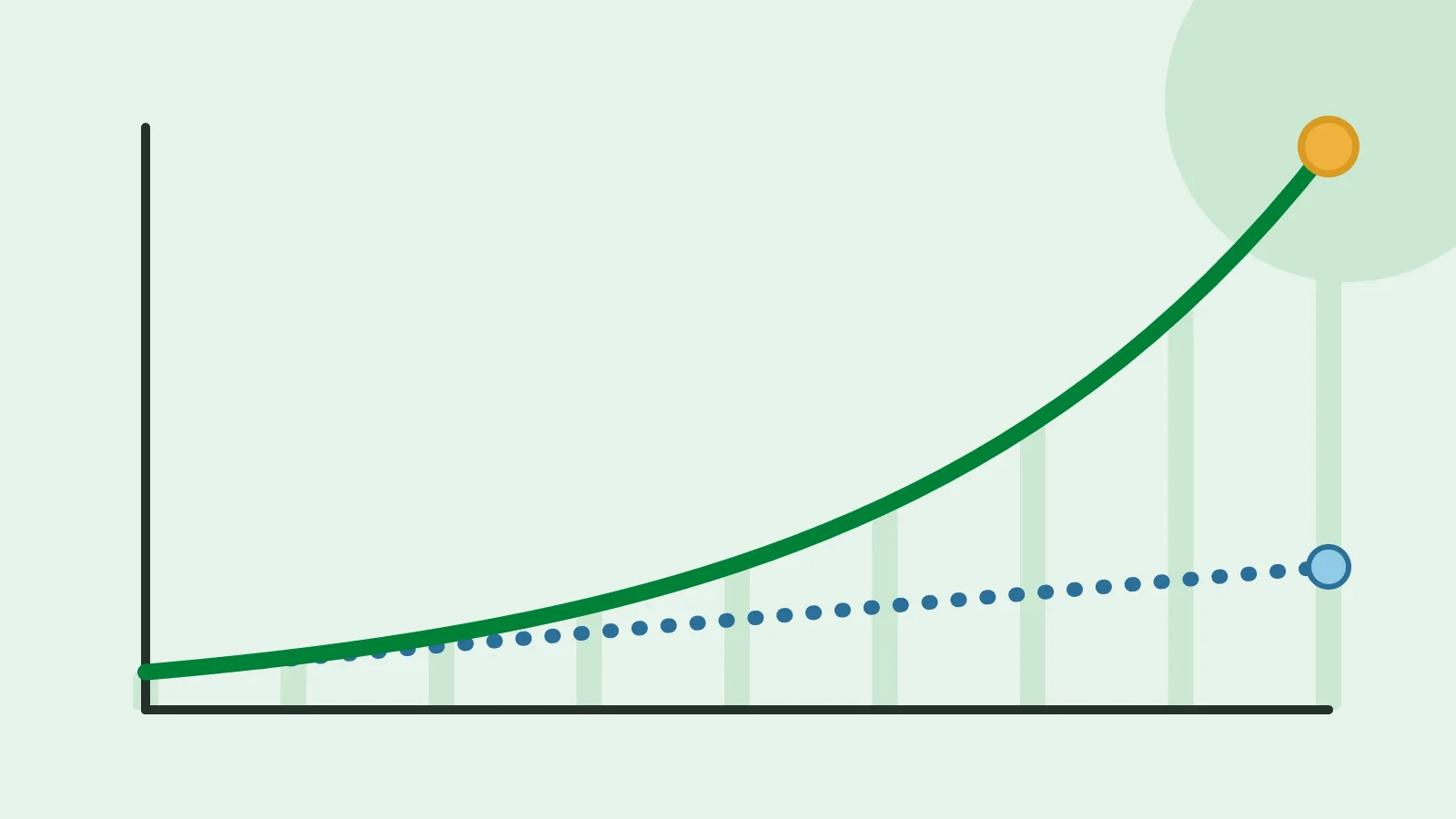
With simple interest you earn a return only on the original amount. With compound interest each year’s return is added to the balance, and next year you earn a return on that too.
Here is 1,000 € growing at 7% a year:
| Years | Simple interest | Compound interest | Difference |
|---|---|---|---|
| 10 | 1,700 € | 1,967 € | 267 € |
| 20 | 2,400 € | 3,870 € | 1,470 € |
| 30 | 3,100 € | 7,612 € | 4,512 € |
| 40 | 3,800 € | 14,974 € | 11,174 € |
After ten years the difference is small. After forty years compound interest has grown the money almost four times as much as simple interest.
Example: 10 € a month from birth
Imagine you start saving 10 € a month for your child at birth, and the child keeps the same 10 € going until the age of 65. In total, 7,800 € is paid in over 65 years.
- At 9% a year, the balance at 65 is about 452,000 €.
- At 6% a year, it is about 96,000 €.
- At 3% a year, it is about 24,000 €.
Even at a modest return the money grows to many times what was paid in, and almost all of the final balance is returns, not deposits. The figures are calculated with monthly compounding. 9% is roughly what US shares have returned historically before inflation, so the 6% figure is closer to what the money would be worth in today’s euros.
Starting early beats saving more
Two savers both earn 7% a year and save 100 € a month:
- Anna saves from age 25 to 35, then stops. She pays in 12,000 €.
- Ben starts at 35 and saves until 65. He pays in 36,000 €.
At 65, Anna has about 140,000 € and Ben about 122,000 €. Anna paid in a third of what Ben did and still ended up with more, because her money had ten more years to compound.
The rule of 72
A quick way to estimate how long it takes money to double: divide 72 by the annual return.
| Annual return | Money doubles in about |
|---|---|
| 4% | 18 years |
| 6% | 12 years |
| 8% | 9 years |
| 10% | 7 years |
Fees compound too
Fees are taken every year, so they compound against you. Saving 100 € a month for 30 years at a 7% return:
- With a 0.2% annual fee (a typical index fund or ETF), you end up with about 117,000 €.
- With a 1.5% annual fee (a typical actively managed fund), you end up with about 91,000 €.
A difference of 1.3 percentage points a year costs about 26,000 € over 30 years. That is why low fees matter as much as a good return.
Compound interest works against you in debt
Credit card and consumer loan interest compounds just as effectively. A 2,000 € consumer loan at 20% interest grows to about 5,000 € in five years if nothing is paid off. Paying off expensive debt is often the best “investment” you can make. If you are in that situation, read steps to becoming financially stress-free.
Teaching compound interest to children
Children understand compound interest best when they can see it:
- Coins or beans. Start with a small pile. Every “year”, add one coin for every ten in the pile. The pile grows faster and faster.
- Their own savings. Show the balance of a child’s savings account or fund once a year, and point out the part that came from returns.
- Matching. If the child saves, add a small bonus each month. It works like a return they can see.
The three money jars method gives children a savings jar where compound interest can do its work. For a longer-term goal, see how much you need to save to become a millionaire.