
Home / Blog / Car Repair
Polaris Ranger Diesel: DEFA Block Heater and Termini II Cabin Heater
On my 2024 Polaris Ranger Diesel the winter heat is two installations. One is a DEFA engine heater in a frost plug on the Kubota, so the coolant is warm before a cold start. The other is a DEFA Termini II 1000, a 230 V electric heater mounted in the cab. The Ranger already has its own cab heat, fed by coolant hoses. That factory circuit stays on the coolant. The Termini is the electric heater, on a cord of its own.
The plate on the engine reads Kubota D902-EF01. DEFA’s fitting table for heater 411167 lists the D902. The row is the D902. My plate adds the EF01 suffix, and the table has no Polaris row. I fitted 411167 on this Ranger on the strength of that D902 row. The limit belongs in the story, along with the steps that stayed off camera and the checks I have not done.
Part 1 is the block-heater film, and it is public.

Part 2 is the inlet socket and the cabin heater. Part 2 publication: 9 November 2026, 16:30 EET.
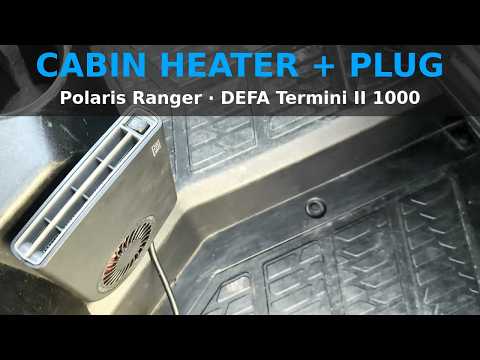
Knocking the frost plug fully out, tapping the heater into the hole, and refilling the coolant happened off camera. Drilling the inlet hole and the final tightening of that socket happened off camera too. What the films do show is the parts, where the plug sits, the access, the screwdriver on the lower edge, the warning about losing the plug inside the block, the heater after it was in, a warm-up check by hand, what the coolant did afterwards, the inlet location, the cable route, the Termini coming out of the box, and the unit mounted and running.
The plate, and the row in the table
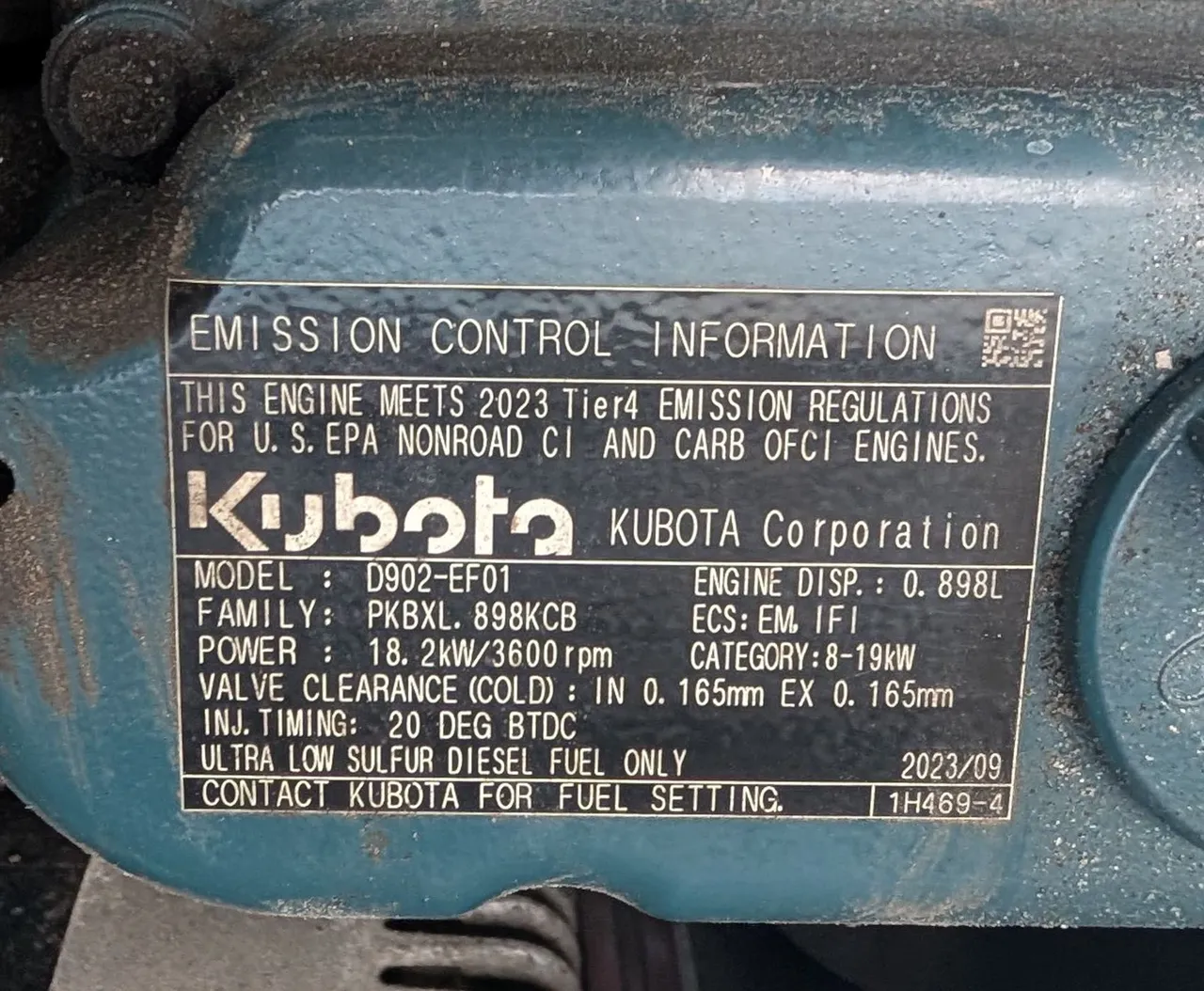
The plate is readable. Model D902-EF01. Displacement 0.898 L. Power 18.2 kW at 3600 rpm. Those three lines are what I set next to the heater sheet. The plate also carries an emissions legend, a family code, cold valve clearance, and injection timing. I left those lines out of the heater decision.
The DEFA 411167 fitting sheet is marked 230 V / 300 W. Its order is to drain the coolant, remove the frost plug the table indicates, clean the hole, set the connector to the clock position in the table, tap the heater in straight, and leave clearance all the way between the heater’s shoulder and the block. Contaminated or old coolant gets replaced. In the Kubota notes in that PDF the outlet is described as pointing at 1 o’clock, followed by a top-up with the coolant the vehicle maker specifies and a bleed done the vehicle maker’s way, then a leak check. The photo of the fitted heater does not establish that clock position on my engine. I did not measure the shoulder gap.
The same sheet says an installation on a vehicle or an engine that is absent from the table is done at your own risk and is not covered by the warranty. The table contains the D902, including on Kubota RTV900 rows. The plate on this Ranger says D902-EF01. Polaris is absent from that table. DEFA also says products in the engine compartment shall be installed by an authorized workshop. I did the engine-bay work on this Ranger myself. That is the account of one machine. The workshop line is still the line on the sheet.
Power stays off until the correct coolant is back in and the system has been bled to the vehicle maker’s specification. DEFA allows an earthed mains socket only, and asks for a continuous earth from that socket to the heater body and on to the chassis.
The bags, and the inlet the kit leaves out
The block heater is DEFA 411167, 230 V. The link above is the fitting sheet I used.
The loom is the DEFA PlugIn branch kit 460768. DEFA’s contents for that kit are a 0.5 m extension (460802), a 1.5 m extension (460843), a Y-piece (460853), and an interior heater socket (460829). The Y splits the supply between the block heater and the cabin heater. The kit stops there. It does not include the inlet, which is the socket the extension lead plugs into from outside the Ranger.
That inlet is a DEFA MiniPlug inlet cable, sold separately. Several lengths exist. I do not have a confirmed item number for the cable on this Ranger, so this page prints none.
The cabin heater is a DEFA Termini II 1000, item 430072, with a Schuko plug, on 230 V. Schuko is the European two-pin plug with side earth contacts. The product sheet rates the output at 1000 W at −25 °C and 800 W at +25 °C. The element is a PTC element, so the output falls as the interior warms. The 1000 W figure is that cold rating. I have not metered the watts on this Ranger, and I have not metered the cab.
On the film I said block heaters exist from other makers, including a Kubota part, and that the cabin heater could have been another brand. Both sentences need the limit that belongs with them. Another block heater is a question for that heater’s own fitting table, on a D902-EF01, rather than a reading of DEFA’s D902 row. A heater in this cab has to be one made for fixed installation in a vehicle interior. DEFA’s Termini guide says to use original DEFA connector kits with original DEFA MiniPlugs, and to connect them only to an earthed socket. The same guide keeps the heater off the floor, keeps the outlet from pointing down, and keeps it off a seat.
Reaching the frost plug
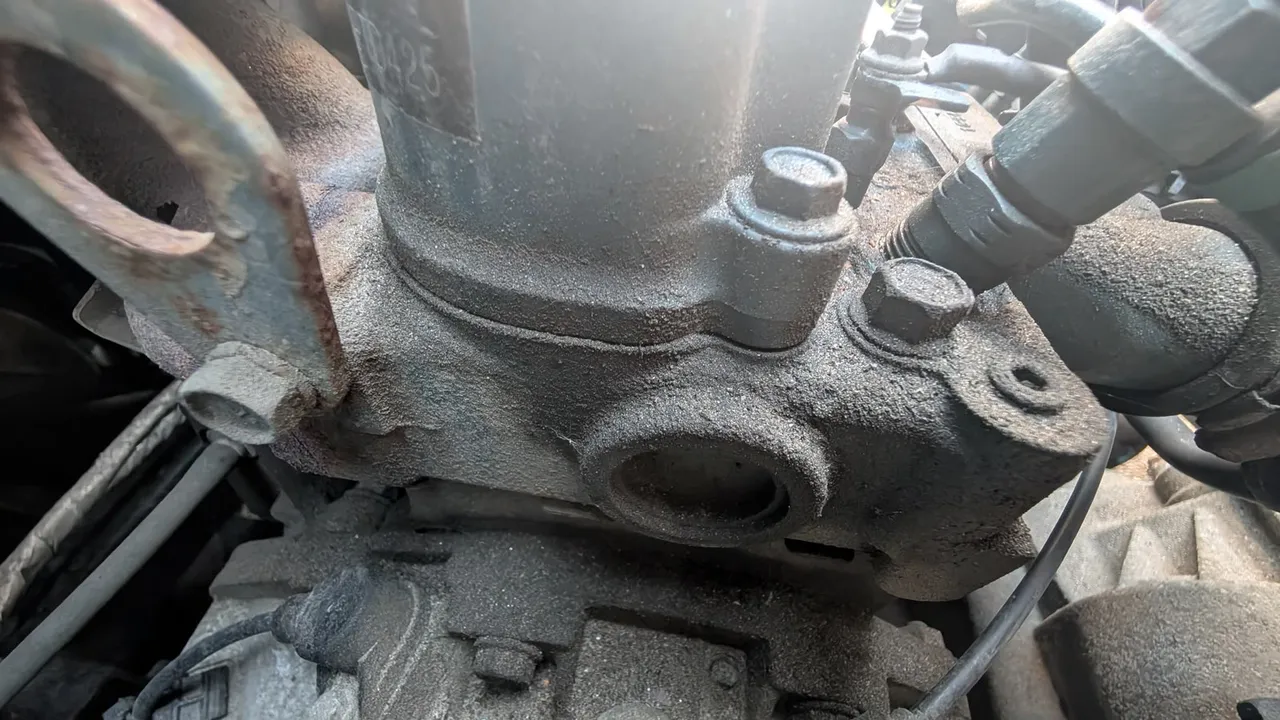
The drawing in the 411167 sheet puts the frost plug at one end of the engine, beside a loop in the picture. On this Kubota that end is not painted the blue of the drawing. The place is still that end. The bed has to be down to see it properly, because the heater ends up on this side of the engine.
With the first cover off, the plug was easier to reach. The next cover looked like six Torx screws, three a side, plus a clamp. That cover turned into a lot of work for the access it bought. A rubber piece in the way would bend enough for a screwdriver, so I left the second cover on.
The usual start is a screwdriver on the lower edge of the plug, hit so the plug twists, then pliers to pull it, then a clean hole before the heater goes in. Coolant comes out as soon as the plug moves, which is why the sheet says to drain some first. In the film a flat screwdriver is on that lower edge, and the plug has already started to move. Getting it fully out happened off camera.
The plug is thick metal. If the lower edge will not start to flip, and the pliers will not enter, stop and look up another method before the next blow. A plug pushed into the water jacket is a miserable thing to fish out. The version of that mistake I want to stay away from is an engine that has to come apart to recover it.
Once the heater was in
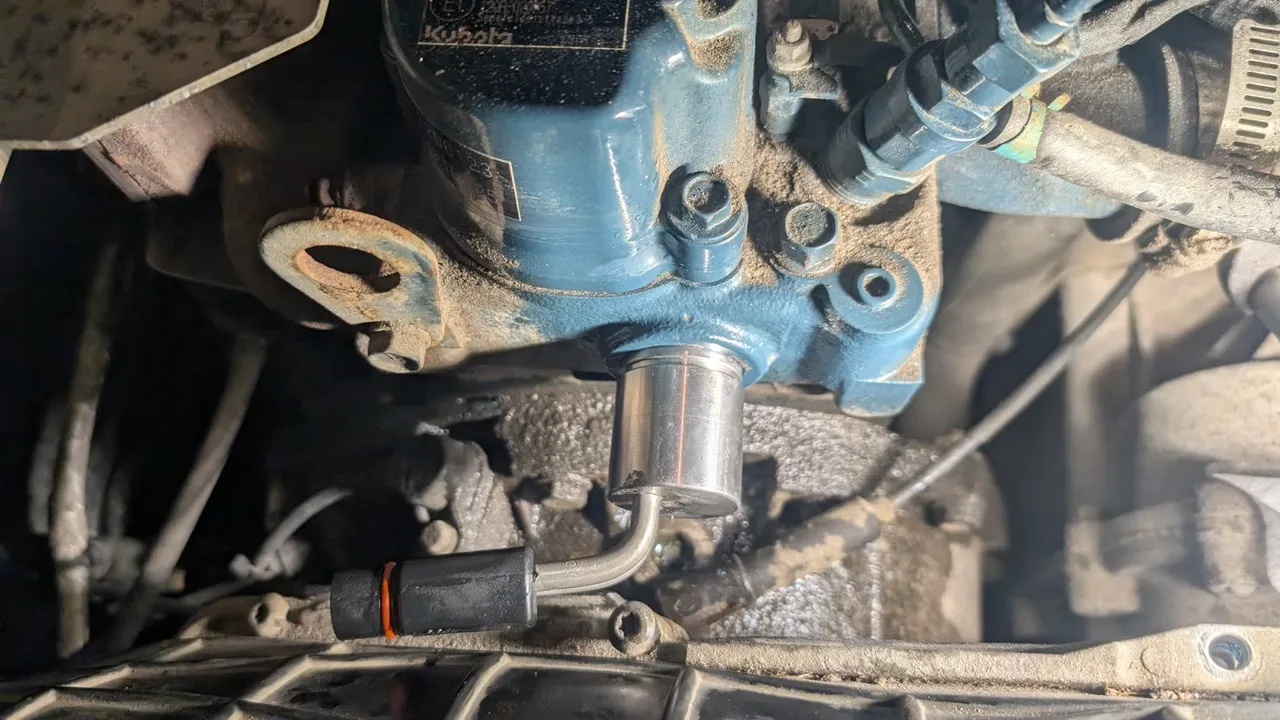
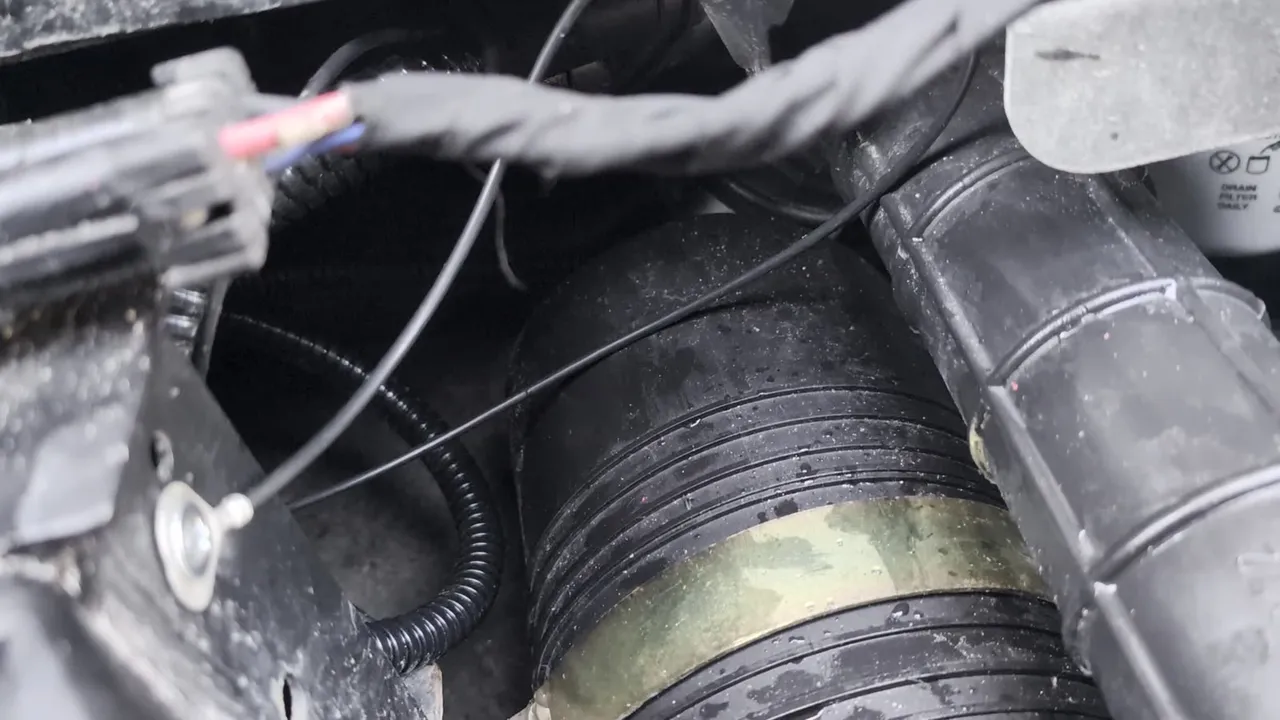
Tapping the heater home was off camera. The part that took the care was supporting it so it went in straight. I used a wrench as a rest down there and a hammer to tap, and that was a shorter fight than getting the plug out without losing it inside the block. The photo is the result: the body in the port, the lead bent down to the black connector with the orange band. The hammer blows are absent from the film.
A hand on the metal
In the film the heater is already plugged in. The body is hot to the touch, and the engine metal above it is hot to the touch as well. The coolant pipe is cold to the touch. The reason I give there is the simple one: the water sits still until the engine runs, so a hot block and a cold pipe can both be true. That check was my hand. I put no thermometer on the block, the pipe, or the cab. This page has no temperature, because I did not take one.
DEFA’s sheet keeps the heater unplugged until the coolant is back in and the system has been bled. Air left in this engine had the block heating hard while the coolant was not moving at all, which is the situation that rule is there for. The bleed story is next, and it is a record of what I did, ahead of any claim that the order matched the sheet.
Air in the coolant
This is the part that took the time, and it is the part to read before anyone copies it. Some of what I did was on a hot engine. The paragraphs below are the record of this Ranger. The procedure to follow is Polaris’ cold-engine fill, or a workshop.
Polaris, in the Ranger Diesel owner’s manual part 9923138, keeps the pressure cap closed while the engine is warm or hot. Steam from that cap burns. Fill slowly at the radiator with the engine cold. Hold the overflow bottle between its cold minimum and maximum. Some drop in level is normal while air works its way out. The coolant named there is Polaris Premium, 60/40 or 50/50, compatible with aluminium, mixed with distilled water. Coolant types stay unmixed. Coolant that was drained gets replaced. The PDF is the 9923138 Ranger Diesel owner’s manual. DEFA says the same gate in its own words: no electrical connection until the correct coolant is in and the system has been bled to the vehicle maker’s specification.
The jacking points for this 2024 Diesel are a different book, manual 9941851, written up in Polaris Ranger jacking points. The lug-nut figures from the winter tire swap on the same machine are in Polaris Ranger lug nut torque.
What I actually went through was this. The block was heating and the coolant was sitting still, and I could not see a sensible bleed point on this engine. I opened the radiator at the front and filled through the cap, ran the engine, and raised the front to try to move the air. The fill Polaris describes is a cold engine. Opening that cap once the system is already hot sits under the same steam warning as a hot hose. Raising the front was short of enough. I then loosened one coolant pipe a little and pulled it back, short of taking it off, and heard the hiss as air came out. A few drops of coolant came with the air. After that the coolant started to move. One pipe got hot to the touch. I ran it again with the cap on. The further pipe got hot, then the radiator, then the outflow pipe. The two pipes that feed the Ranger’s own coolant cab heater were the stubborn pair. One was hot and the other stayed cold until I revved the engine, and then the cold one joined. I let the engine and the coolant cool all the way down, and added coolant at the radiator again. From there the plan was a drive, and another look once it had cooled, in case the level wanted more.
That loosened pipe was a hot, pressurised cooling system. Never open the radiator cap on a hot engine. Never loosen a hose on a hot, pressurised system. Follow Polaris’ cold-engine fill and bleed procedure, and DEFA’s fitting instructions, or hand the Ranger to a workshop. A shop with a pressure filler is the better way to chase the air pockets. I said that on the film because the driveway version ate the afternoon.
The bleed is unfinished as a proof. There is no completed test drive on this page, and I have not shown that the last air is out. A level that looks right before a drive can still move after one. The check, when it happens, is on a cold engine, at the radiator and at the overflow bottle, the way that Polaris manual describes.
The pipes that stayed uneven are the Ranger’s coolant-fed cab heat. The Termini is the electric heater, on its own cord.
The inlet on the front panel
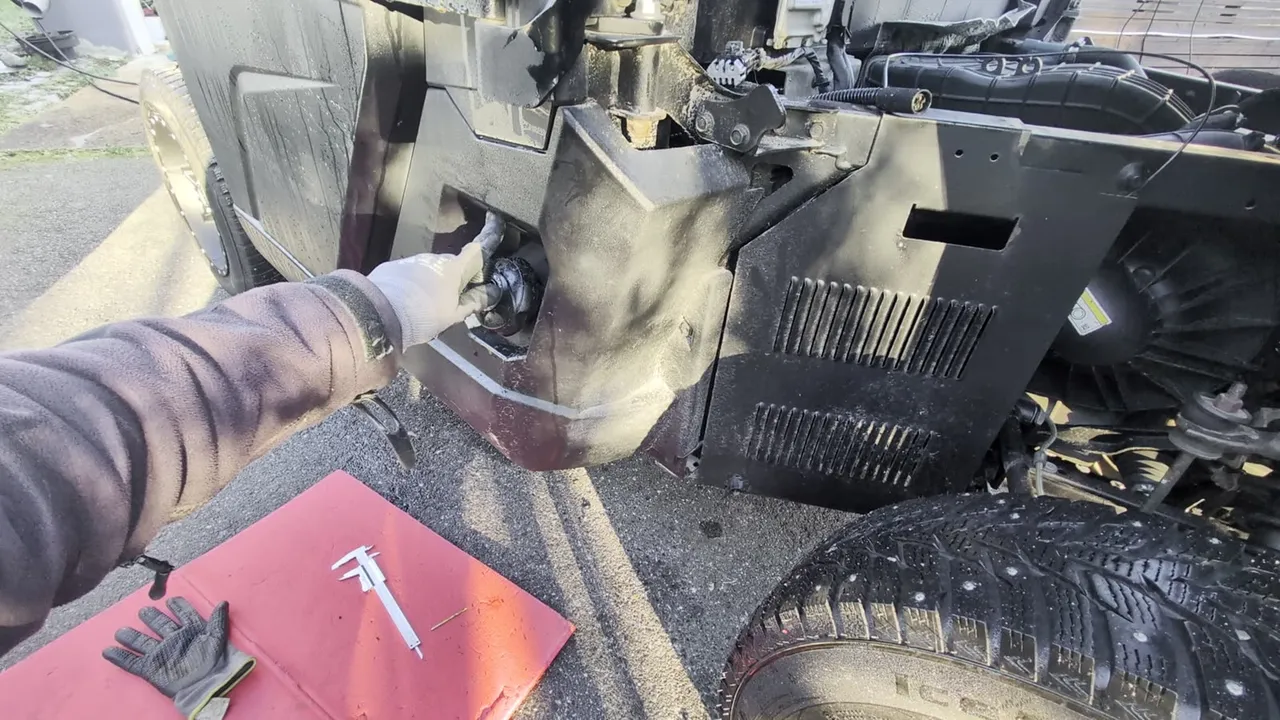
The inlet is the piece kit 460768 leaves out. DEFA’s MiniPlug instructions call for a 24 mm hole plus a small keyway for the index tab, an O-ring between the nut or ring and the panel, and the socket face angled slightly downward so water and condensation can drain. The earth lead, on its ring terminal, goes to the chassis or to the original earth point, on bare metal. The cable goes on the vehicle first, then onto the mains, and the cover stays on when the lead is packed away. Those are DEFA’s rules. The product page is the MiniPlug inlet cable.
On this Ranger the through-panel mounting was the one that made sense. The larger piece, the one the instructions mark F, screws onto the cable and is what holds the O-ring. The O-ring goes on first, then the holder, then that F piece, and the three of them finish on the inside of the panel. The O-ring is the seal in that stack. DEFA’s instruction puts it between the nut or ring and the panel, and that is the fit I used.
I kept the DEFA logo readable, which puts the socket upright or on its side. The printed rule for water is the face angled slightly down, so the socket drains instead of holding a puddle. I have no waterproof claim for the joint.
The hole itself was drilled off camera, in the front panel, where there was room behind the skin and a little tilt so water and ice have a harder time sitting on it. The cable fed through from the outside. The small notch for the index tab is on the top side of that hole, so the socket stays put in rotation. Tightening it from the back was by feel, and that too was off camera. The lead from the block heater and the lead from the interior socket both arrive in this area.
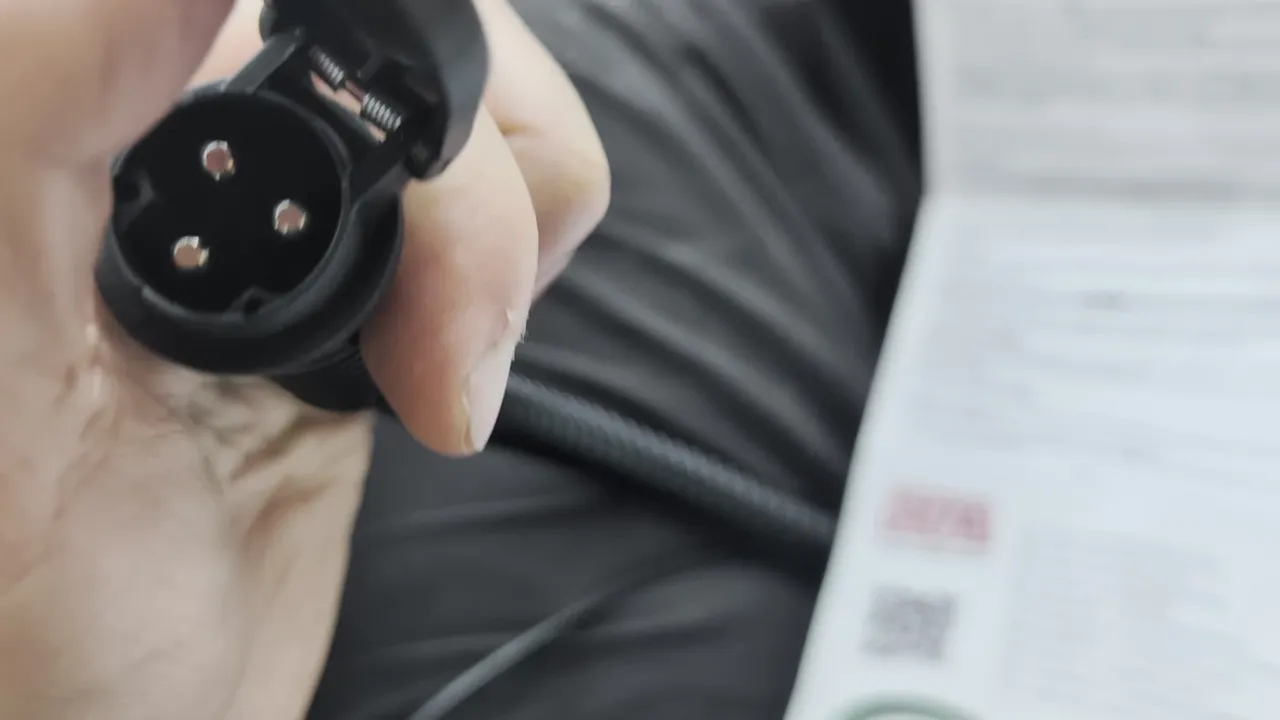
The close-up is the plug face: cover open, three pins, the lead in its corrugated sleeve. The paper at the right is out of focus, so I am not reading a torque, a length, or an item number off it. The ring terminal is absent from these frames, and so is the bare metal it is supposed to land on. I have not tested continuity. DEFA’s earth rule still stands. This page does not certify that the earth is good.
The socket sits where the plugged-in lead partly blocks the fuel filler. The lead comes off before the Ranger moves. That was the compromise for a spot out of the wheel well, on a panel that already tilts.
The Termini, which is a different heater
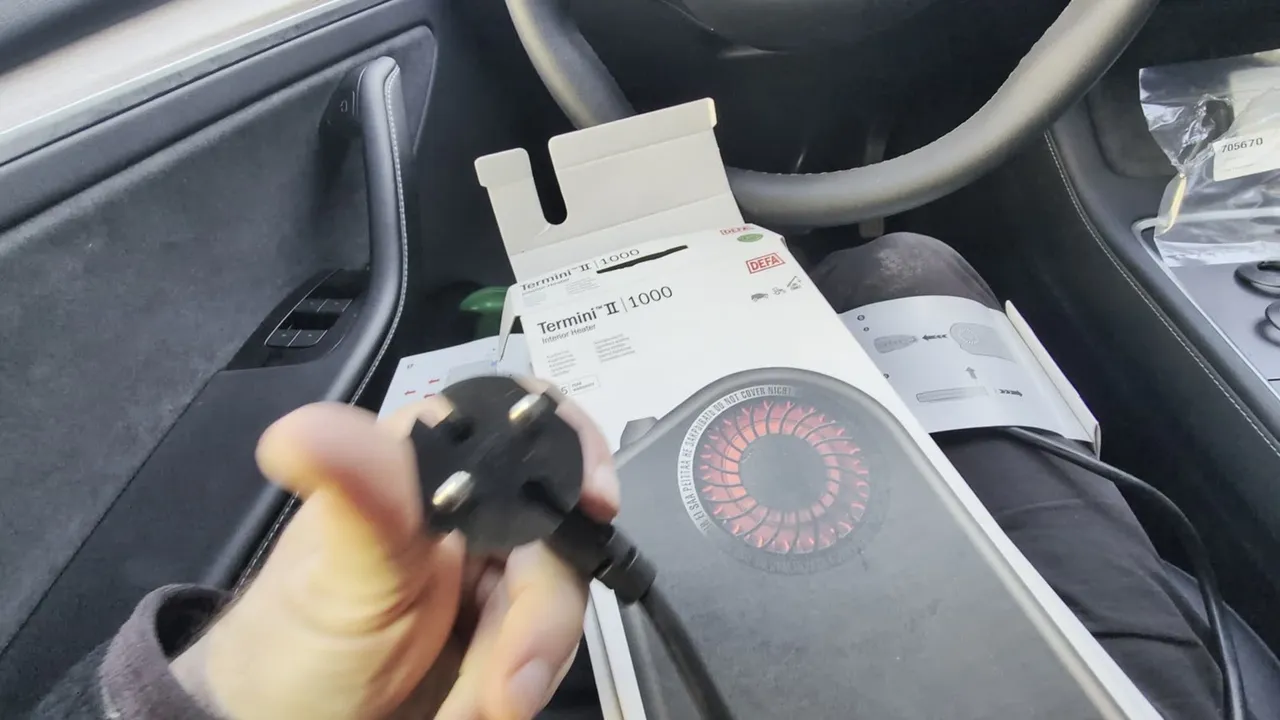
Item 430072 is a thin 230 V interior heater. On the Termini II 1000 sheet the output is 0 to 1000 W at −25 °C and 0 to 800 W at +25 °C, with a rated output of 1000 W. An overheat breaker trips at 55 °C and resets after the plug has been out for about 30 minutes. A further thermal fuse, around 80 °C, means a factory repair if it opens. The heater stays uncovered. Every one of those figures is DEFA’s. None of them was measured in this cab.
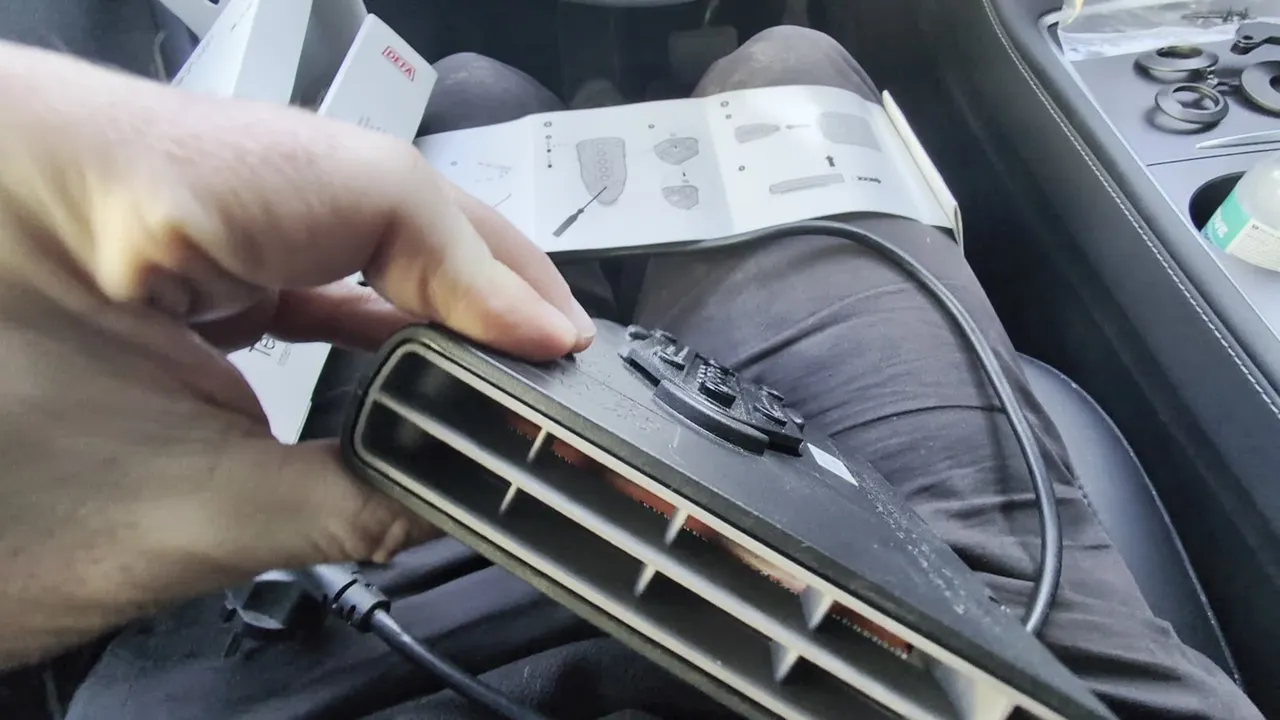
The bracket comes off with a small flat screwdriver under the snap, pushed back the way the guide draws. Hot air leaves the grille. For an ordinary car the guide’s places are the centre console, under the glovebox, or the A-pillar. The spacing drawing in the Termini II user guide asks for those gaps to be met: at least 50 mm at the intake, and at least 300 mm free in front of the outlet. DEFA points that guide at the 1000 as well; the PDF cover also reads Termini II 1400/1900. I have not measured the gaps on this Ranger and written the numbers down.
The bracket takes three of the enclosed screws, spread as far apart as the holes allow, and the drill has to miss whatever cable is hiding behind the panel. The box includes a drilling template, four screws, and four rubber pieces. I mounted this one with three screws and kept one screw spare.
Where it sits in the cab
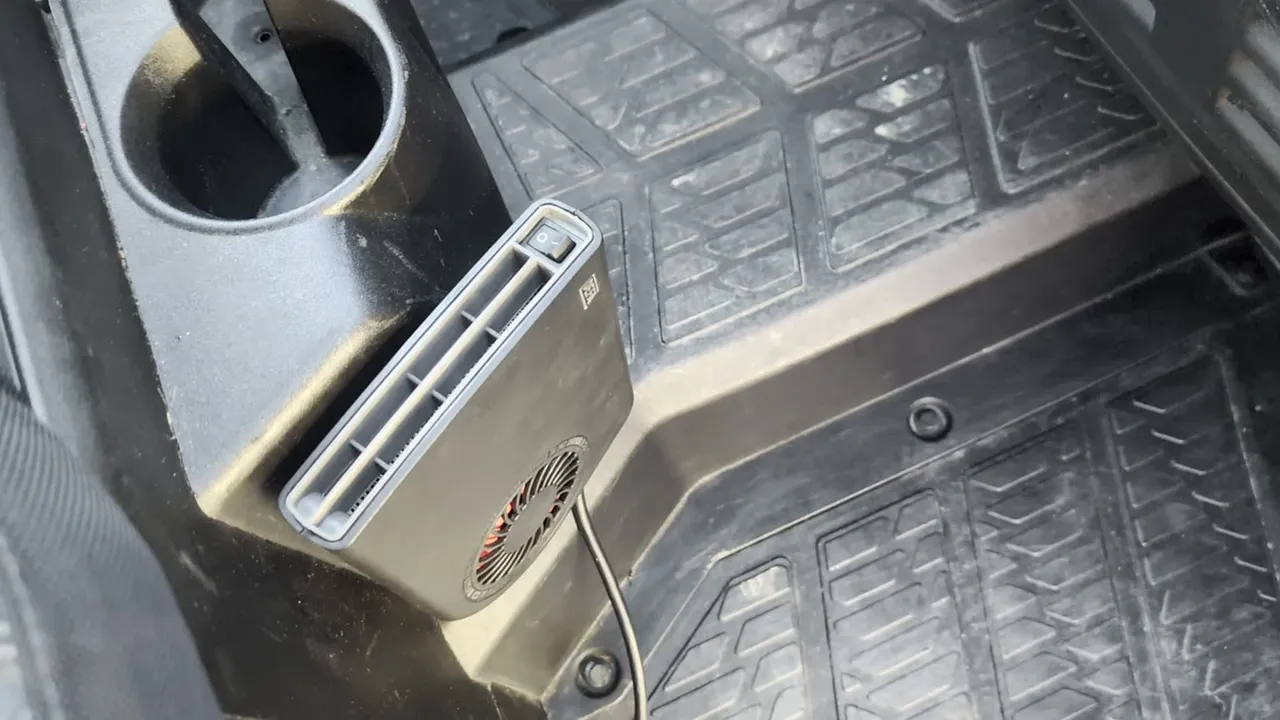
I tried a spot that would have blown upward, and I tried the centre. The centre panel is uneven, and the side is less in the way of legs and bottles. It finished on the passenger side of the centre console, next to the cup holder, up off the floor mat. That sits inside DEFA’s placement limits: off the floor, outlet kept off the downward aim, kept off the seat. I have seen other Rangers with a heater in a similar place. That is a driveway observation. It is short of a measured 50 mm at the intake and a measured 300 mm in front of the outlet, and it is short of DEFA signing off this exact panel.
With the heater running, the cab felt warm. I switched it off so the camera audio would be usable. “Felt warm” is the whole result. No thermometer, no wattmeter, no timed heat-up from a known cold soak.
The lead comes through the battery compartment, which opens without a fight, and runs across to the Y. On the film you can follow the cable. The Y stays out of the shot. The cabling was the easy part of the job. The frost plug, and the air in the coolant, were the long parts.
Still open on this Ranger
A few things would be easy to over-read from the photos, so they stay listed.
- The D902 is the engine in DEFA’s 411167 table. The plate on this Ranger reads D902-EF01, and the table has no Polaris row. The sheet’s own-risk and warranty sentence is about an engine or a vehicle that the table does not list. Engine-bay installation, in that same sheet, belongs with an authorized workshop.
- The MiniPlug inlet on this Ranger has no confirmed item number here. Kit 460768 does not contain it.
- The earth lead is DEFA’s rule: bare metal, chassis or the original earth point. These photos do not show the terminal, and I have not tested continuity.
- The block, the pipes, and the cab were hand checks. There is no measured temperature and no measured heater output.
- The coolant may still want a cold check after a drive. That drive is not written up here, and a finished bleed is not shown.
- The 1 o’clock outlet, the shoulder clearance, and the Termini’s 50 mm and 300 mm gaps are DEFA’s requirements. I have not published measurements of them on this vehicle.
- Off camera: the frost plug coming fully out, the heater being tapped in, the coolant refill, the inlet hole being drilled, and the inlet’s final tightening.
The documents
- DEFA 411167 fitting instructions. The D902 table, the frost-plug steps, the 230 V / 300 W marking, the bleed-before-power rule, the earthed socket, and the workshop line.
- DEFA PlugIn branch kit 460768. The two extensions, the Y-piece, and the interior socket.
- DEFA MiniPlug inlet cable. The outside socket. The item number on this Ranger is unconfirmed.
- DEFA Termini II 1000. Item 430072, the cold and warm output ratings, and the mounting limits.
- Polaris Ranger Diesel owner’s manual 9923138. The pressure cap, the cold fill, the overflow bottle, and the coolant specification. Jacking points for this 2024 Diesel are the 9941851 pages in the jacking article.
FAQ
Does the DEFA 411167 fit a Polaris Ranger Diesel?
On this Ranger the engine is a Kubota D902-EF01, and DEFA’s 411167 table lists the D902. That row is the reason I bought this heater. The table has no EF01 line and no Polaris line. DEFA says a fit on an engine that is absent from the table is at your own risk and outside the warranty, and that an engine-compartment install shall be done by an authorized workshop.
Is the Termini the Ranger’s cab heater?
The Termini II 1000 is a 230 V electric heater, item 430072. The Ranger’s cab heat is a coolant circuit with hoses of its own. They can both be warm on a winter morning, and they remain two systems. The block heater warms the coolant in the engine. Until the engine runs, the coolant pipe on mine stayed cold to the touch while the heater body was hot.
What does the 1000 W rating mean?
DEFA rates the Termini II 1000 at 1000 W at −25 °C and 800 W at +25 °C. The element gives up output as the cab warms. I have not measured the output in this Ranger. The figure is the rating, taken from the product sheet.
Does the wiring kit include the outside plug?
Kit 460768 includes the Y-piece, a 0.5 m extension, a 1.5 m extension, and the socket inside the cab. The MiniPlug inlet is a separate cable. I do not have a confirmed item number for the one on this Ranger.
Can the radiator be opened to bleed it while the engine is hot?
The pressure cap stays shut on a warm or hot engine. Polaris warns that the steam burns. Fill and bleed on a cold engine, the way manual 9923138 describes, and leave the block heater unplugged until that is done. A hose on a hot, pressurised system stays tight. Loosening one was something I did on this Ranger, and it is absent from the procedure I would hand to someone else.
Where did the cabin heater end up?
On the passenger side of the centre console, beside the cup holder, with the lead dropped through the battery compartment. DEFA’s limits are a heater off the floor, an outlet kept off a downward aim and off the seat, at least 50 mm at the intake, at least 300 mm clear in front of the outlet, and the unit left uncovered. I chose the side because the centre panel was uneven and the side stays out of the way. The clearances on this Ranger are unmeasured.
Are there temperatures, or a test drive?
Hand checks only. The block and the upper engine felt hot, the coolant pipe felt cold until the engine ran, and the cab felt warm with the Termini on. I have no thermometer readings, no completed test drive written up, and no demonstration that the bleed is finished. After a drive, the next look is a cold engine.
When is the second video public?
Part 2 publication: 9 November 2026, 16:30 EET. Part 1, the block heater, is the public film at the top of the page.