
Home / Blog / Car Repair
Polaris Ranger Jacking Points: Where to Lift It Safely (2024 Diesel)
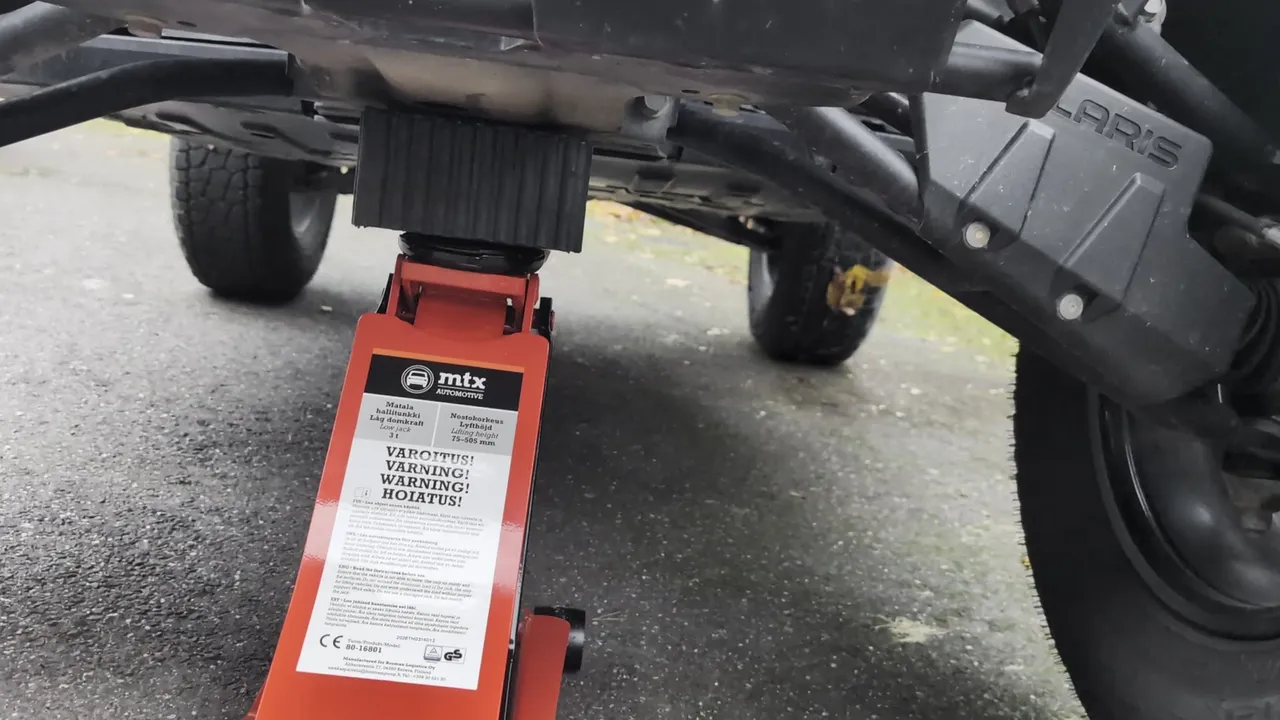
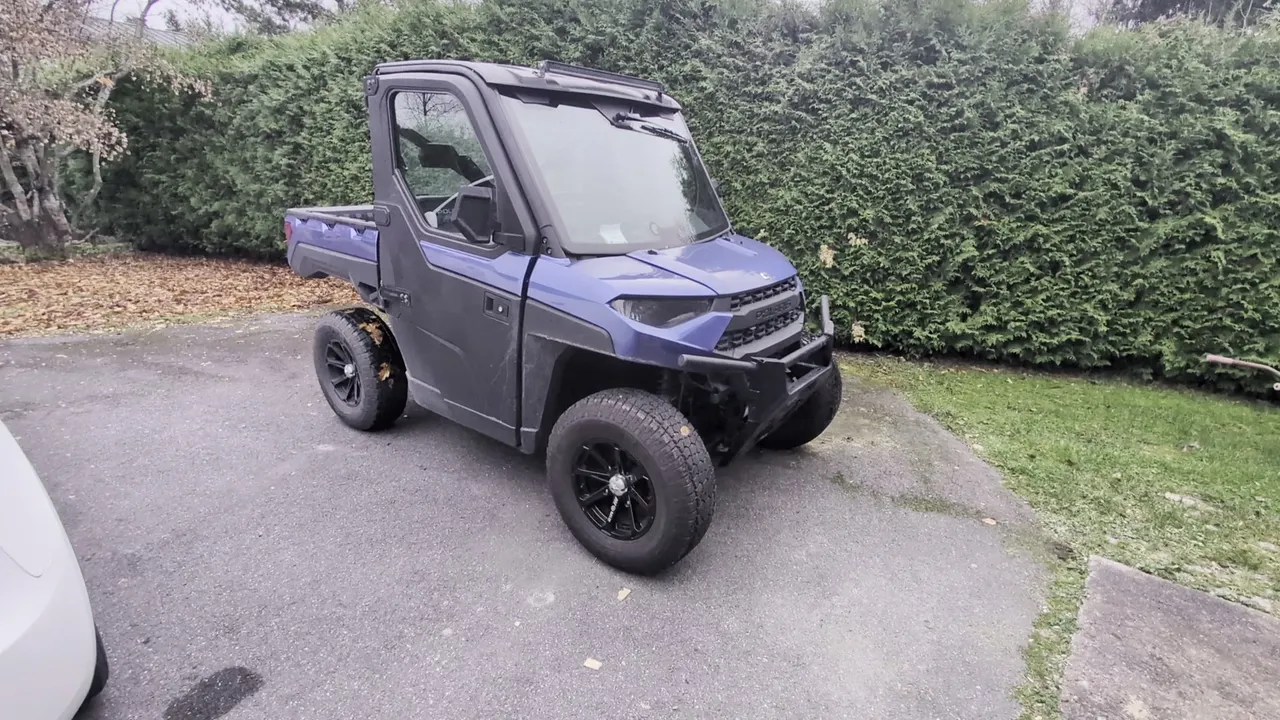
On my 2024 Polaris Ranger Diesel the jack goes on the chassis, at the points the owner’s manual marks with a 1. Under the front, that point is a piece of the frame. At the rear, it is the end of the metal frame next to the wheel. The plastic beside that frame end is not a jacking point. The same two points are on the other side.
Height is the other half of the job. The 2-ton floor jack I already owned lifts from 130 to 350 mm, and that was not enough to get a tire off the ground. The jack I bought for this winter tire swap is an MTX Automotive 3-ton low jack, Motonet code 80-16801, and the label on it reads 75–505 mm. I guessed the Ranger would need about 600 mm of lift. That guess is mine. I did not measure it, and it is not a figure from Polaris. With a thick rubber block on the saddle, the 505 mm jack lifted the wheels clear, and I think it might have reached without the block.
Once the wheel is off, the torque is a separate job. The numbers for this same swap are in Polaris Ranger lug nut torque: 163 N·m or 81 N·m?.
The video of the lift is below. It goes public on 2 November 2026 at 16:30 EET.

Check the manual for your own Ranger
This page is the 2024 Ranger Diesel I own. The book in the photos is that model’s owner’s manual, Polaris part 9941851, and the Jacking Points page sits under Maintenance. Polaris publishes the same page online: Jacking Points, Ranger Diesel owner’s manual.
Other Rangers do not automatically share this layout. The lug-nut table is the proof that the books diverge. The 2025 Ranger 1000 manual lists the same 163 N·m and 81 N·m split I use in the sister article, and the 2026 Ranger 500 manual does not. Jacking points can differ the same way. Open the manual for the Ranger you are lifting, and use the points that book marks.
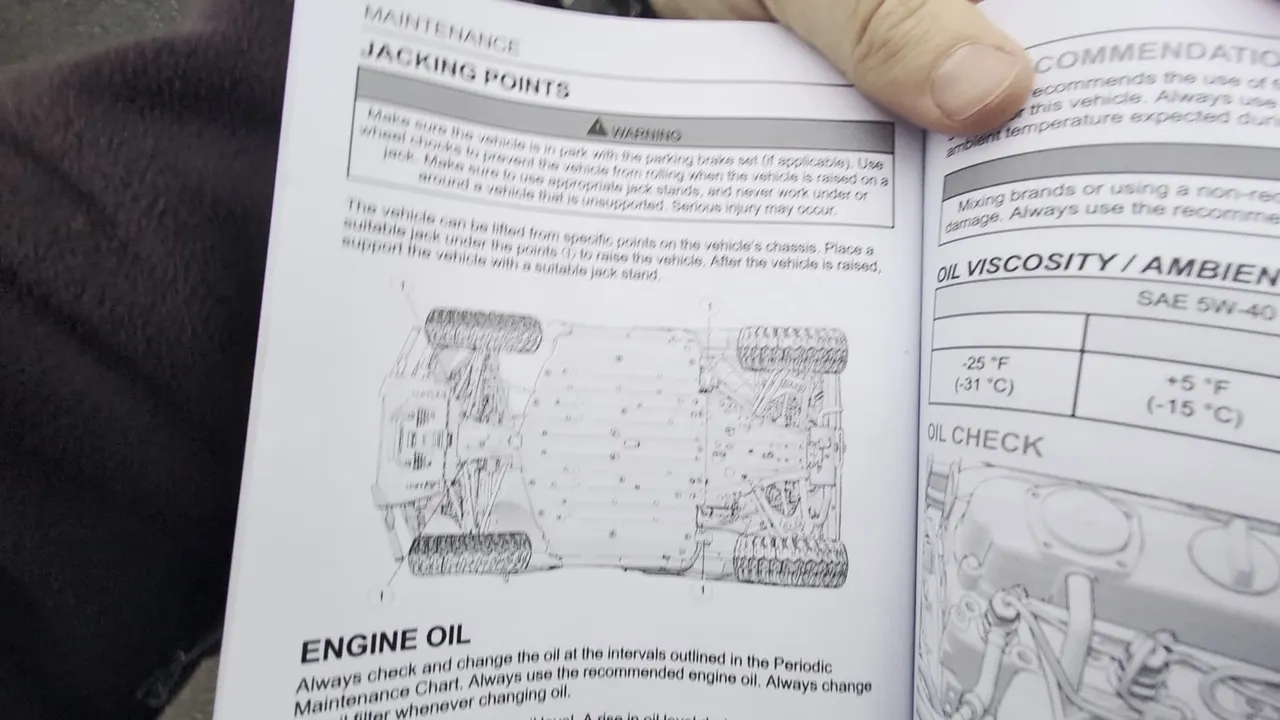
What the Jacking Points page tells you to do
The warning at the top of the page is the whole safety brief. Park the vehicle. Set the parking brake. Use wheel chocks so it cannot roll while it is raised. Support it with a jack stand. Do not work under a vehicle that is supported by the jack alone.
Under the warning, the instruction is to lift only from specific points on the chassis. The diagram is a view from underneath. It marks four points, one near each wheel, each labeled 1. Place a suitable jack under those points, raise the vehicle, and then support it with a suitable jack stand.
A decal on the machine describes the jacking positions as “beneath the vehicle’s center points.” I used that line as a check against the plastic. The point is on the frame, not on a body panel.
The front point, on the vehicle
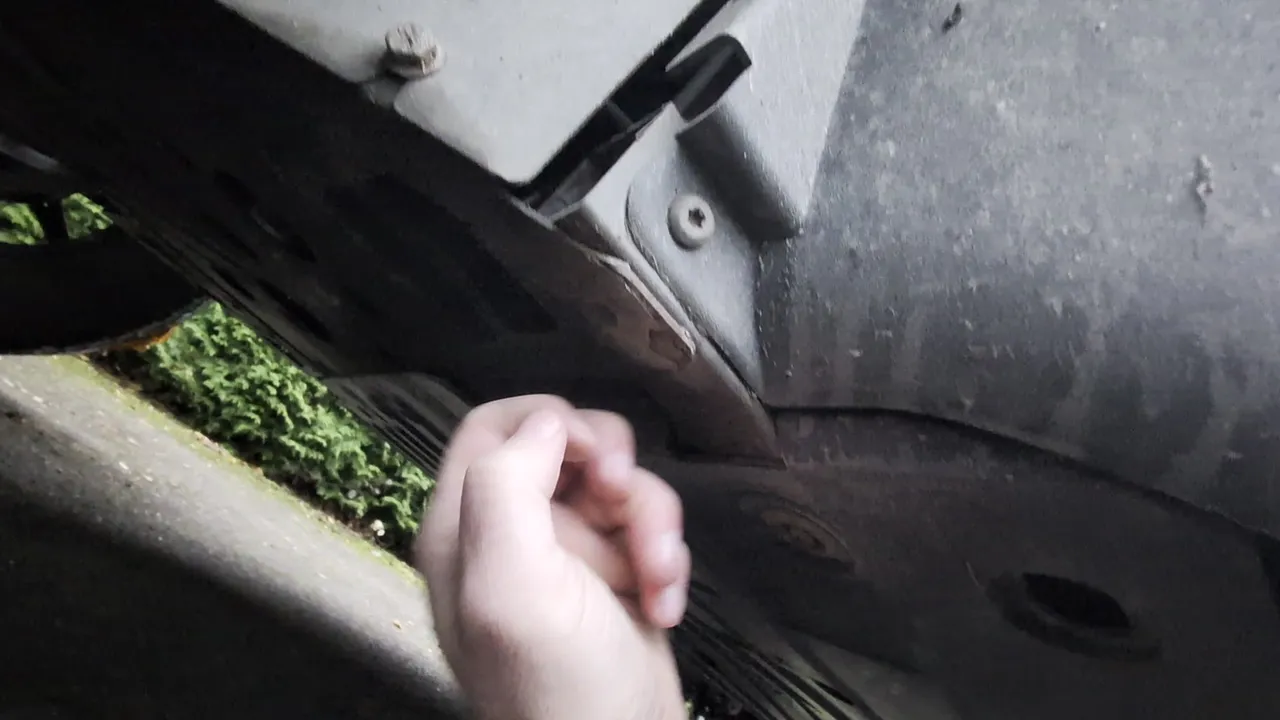
At the front I got under the Ranger and looked for metal. The point is a piece of the frame, the member the manual marks near the front wheel. The saddle goes in the center of that piece. The plastic above the frame is bodywork, and it is not the point.
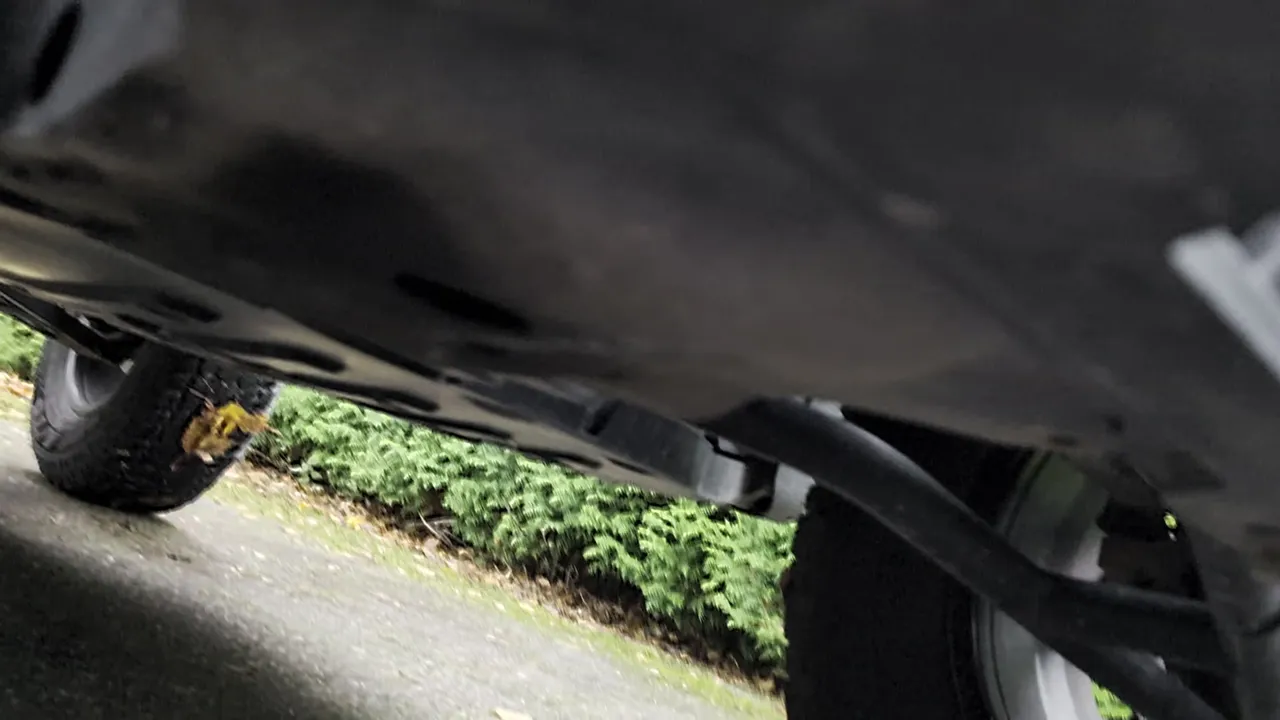
The rear point, and the plastic next to it
The rear point is easier to miss, because plastic sits right beside the metal. Close to the rear wheel, the point is the end of the metal frame. Drop your eye a little and the split is obvious: a plastic panel, then the frame coming to an end. The manual means that metal end. The plastic will flex, and it is not one of the points marked 1.
The other side matches. Front frame piece, rear frame end, both sides. I did not lift from an axle tube, a control arm, or the plastic along the rocker.
Is the floor jack tall enough?
My old jack was rated at 2 tons, which is enough capacity for this job. Its lifting height was 130–350 mm, and the height is what failed. At 350 mm the saddle can meet the frame and still be out of travel, with the tire on the ground.
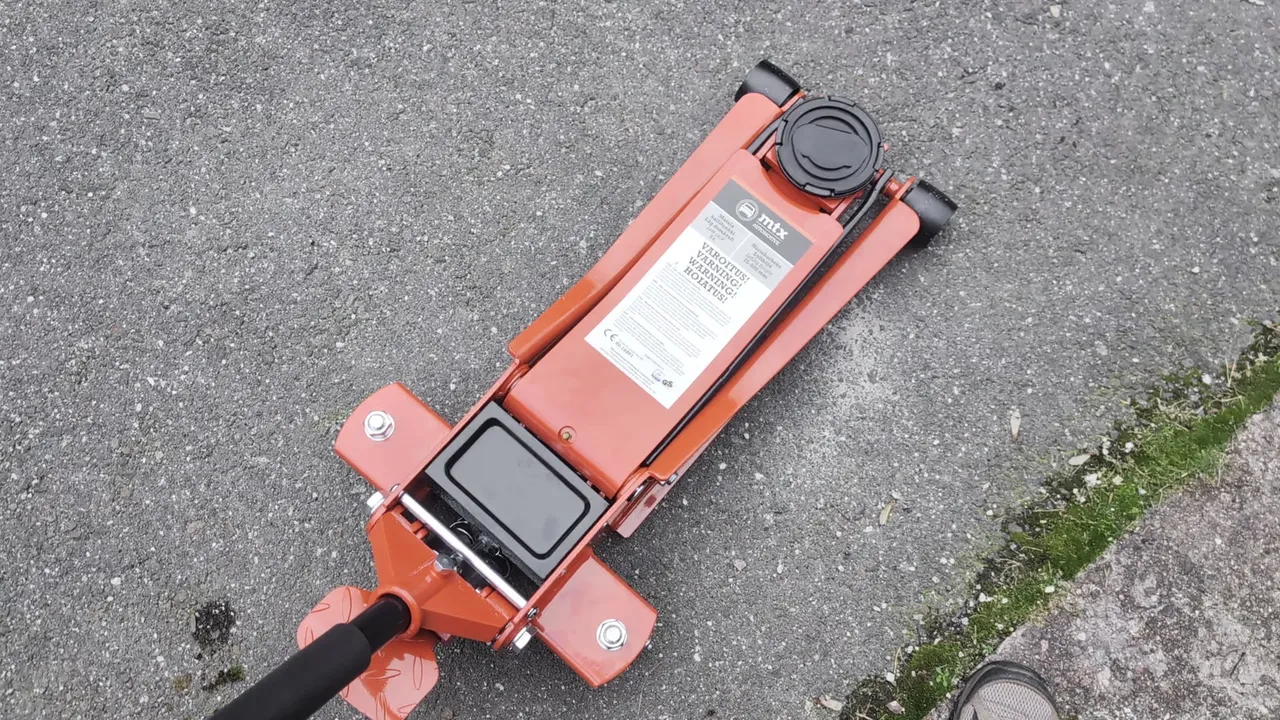
The replacement is the MTX Automotive 3-ton low jack in the photos. It has a foot pedal. The code on the jack is Motonet 80-16801. The label gives the lift as 75–505 mm. The low number is what gets the saddle under the frame. The high number, 505 mm, is the one I had to compare with the Ranger.
| Jack | Capacity | Lift range |
|---|---|---|
| Floor jack I already had | 2 t | 130–350 mm |
| MTX Automotive low jack, Motonet 80-16801 | 3 t | 75–505 mm, from the label |
| Height I thought this Ranger needed | About 600 mm, my own estimate |
About 600 mm is my estimate of the lift I thought I would need. I did not measure a frame and subtract a jack to produce it. It is not in the owner’s manual, and it is not a Polaris specification.
What happened is more useful than the guess. I stacked a thick rubber block on the saddle because I did not trust 505 mm. A piece of plywood adds height the same way. With the block in place, the tires came off the ground. Afterward I think the jack might have reached without the block. The 600 mm guess was high. The 350 mm jack was not enough.
A Polaris dealer specification for the EU-spec Ranger Diesel HD lists 33 cm of ground clearance. That is the gap under the vehicle while it sits on its tires. It is not a jacking height, and it is not the 600 mm estimate.
How I lifted it
This is the sequence from the driveway. If your manual shows a different point, use that point.
- Park, shift into park, and set the parking brake. The manual’s warning starts there.
- Chock the wheels that stay on the ground. I put a block of wood in front of the tire and another behind it. The manual asks for wheel chocks so the Ranger cannot roll once a tire is in the air.
- Find the point in the book, then find that metal on the frame. Front: the frame piece. Rear: the frame end by the wheel, not the plastic.
- Read the jack’s maximum lift. A maximum around 350 mm was not enough on my Ranger. If you are short, add a rubber block or plywood between the saddle and the frame, and keep it centered.
- Center the saddle on the point. A saddle that is half on the frame will kick off as the load comes on.
- Leave the jack free to roll forward. As the arm rises, the saddle moves toward the handle. A blocked wheel makes the saddle walk off the point.
- Pump with the handle. This jack has a foot pedal, and on this Ranger I used the handle. Stop if the saddle drifts off the frame.
- Stop when the tire is clear and the Ranger is stable on the point. Put the jack stand under the frame before the wheel comes off.
Make it safe before the wheel comes off
A floor jack lifts. It is not the support you work beside once the wheel is off. The manual says to support the vehicle with a jack stand after it is raised, and never to work under a vehicle that is unsupported. Pulling a wheel and leaning in toward the hub is already working around a raised vehicle.
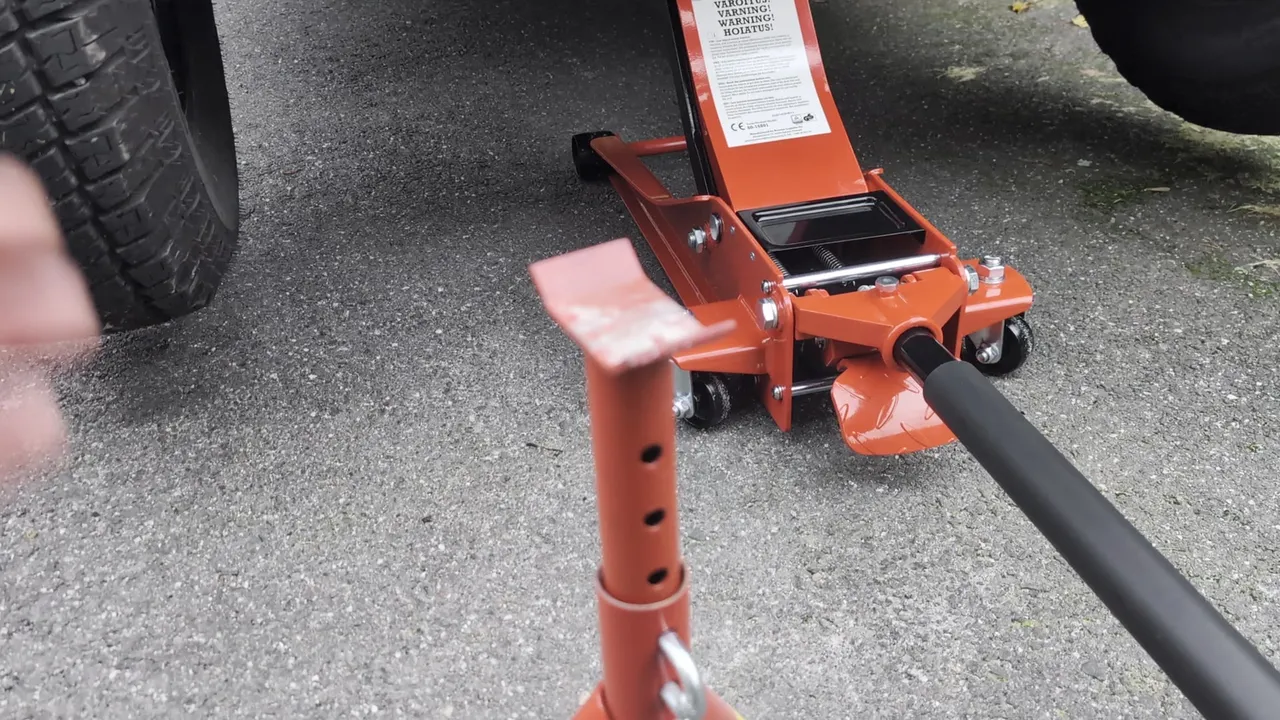
The Ranger can tip with a wheel off. That is why the stand goes in before the lug nuts come all the way off. I set the stand under the frame while the jack is still holding the lift. The jack can stay snug against the point as a backup. The stand is what I trust if the hydraulics bleed down.
In the photo the stand is still beside the jack, which is why the wheel is still on. I do not get under the machine at that stage.
Park, the parking brake, and a block in front of a tire that is still on the ground, plus another behind it, stay in place after the stand is set. One stand under the side you lifted is the minimum I use for a single wheel. I would add a second stand if both ends of one side were in the air.
Gear for this lift
The jack in the photos is the MTX Automotive 3-ton low model, Motonet 80-16801. MTX is a Motonet brand, so the floor jack below is a similar 3-ton low-profile jack, not that exact model. The stands, the rubber pad, and the wheel chocks are the other pieces for this lift. Plywood adds height the way the rubber block did. The torque wrench is for the lug nuts on the same swap.
3-ton low-profile floor jack (similar to the one I use)
FAQ
Where do you jack a Polaris Ranger?
On this 2024 Ranger Diesel, only at the chassis points marked 1. Front: a piece of the frame. Rear: the metal frame end by the wheel, not the plastic. Both sides match. The decal says “beneath the vehicle’s center points.”
Is a floor jack that lifts to 350 mm tall enough?
It was not, on my Ranger. That jack was rated 2 tons with a 130–350 mm lift. Capacity was fine. The maximum height was the problem. The MTX jack, labeled 75–505 mm, lifted the tires clear with a thick rubber block on the saddle.
Where does “about 600 mm” come from?
It is my estimate. I did not measure it, and Polaris does not publish it. The lift that worked was the labeled 505 mm jack plus a rubber block.
Can the floor jack be the only support?
No. The manual says to support the vehicle with a jack stand after you raise it, and never to work under an unsupported vehicle. I put the stand under the frame before the wheel comes off. Park, the parking brake, and chocks stay on as well.
Which wheels get the chocks?
The wheels that remain on the ground. I put a block of wood in front of that tire and another behind it. The wheel that is about to come off cannot hold the Ranger.
Does this apply to every Ranger?
It applies to the 2024 Ranger Diesel in manual 9941851. Other models use different specifications. The 2026 Ranger 500 lug-nut table is already different from this Diesel. Open Jacking Points in your own manual.
What comes after the wheel is off?
Torque, with the tire back on the ground. On this swap the aluminum wheels took the manual’s aluminum figure. The socket, the star pattern, and the steel-wheel figure are in the lug nut torque article.