
Home / Blog / Car Repair
Michelin X-Ice North 4 on my Mercedes EQE: size, DOT code, and stud break-in
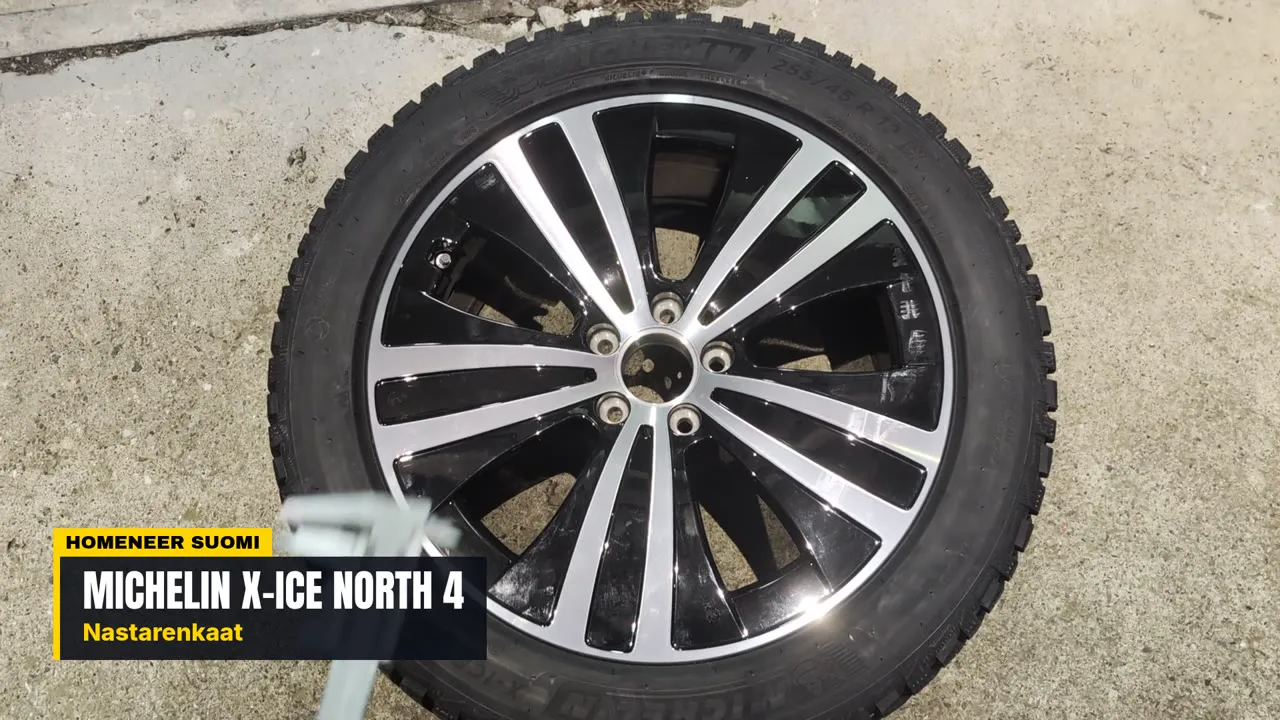
I fitted a new set of Michelin X-Ice North 4 studded winter tyres to my Mercedes-Benz EQE on 31 October 2026. The size on the sidewall is 255/45 R19 104H XL. The DOT date is week 19 of 2026, and the tread I measured while the tyres were new was about 8.5 mm.
What follows is that fitting, written so the markings are usable the next time a set goes on a car. I cover how to read the size and the date code, why the new tread depth is worth writing down, where I bought the tyres, how I am breaking the studs in, and when studded tyres are allowed in Finland. The notes stay with what I measured on this set and with the public rules from Traficom and Liikenneturva.
The video is on Homeneer Suomi, and the spoken track is Finnish. This page is the English account of the same job.

Why I fitted these tyres
The EQE is the car I drive through a Finnish winter, and I wanted studs for ice. Friction tyres are the other legal winter option here. I chose studs, and the tyre is the Michelin X-Ice North 4, a new set in 255/45 R19.
I put the wheels on about a week before the forecast called for frost and, possibly, the first snow. That gap is deliberate. New studs need a stretch of milder driving before I ask them to work on ice. The break-in is below, with the wheel-bolt check that follows any wheel coming off the car.

On a new tyre I write down five things before the car goes back into daily use: the full size, including load index, speed rating, and XL; the DOT week and year; the tread depth; the date and the shop; and the kilometre readings where the bolt check and the stud seating will be done. Those five lines are the whole record. Everything else in this article is how to fill them in.
How to read 255/45 R19 104H XL
The size is moulded in large characters on the sidewall, and again in the smaller service description under it. On these tyres the large line is 255/45 R 19, with a three-peak mountain and snowflake beside it. The smaller line reads 255/45R19 104H, and EXTRA LOAD is moulded further along the same sidewall.
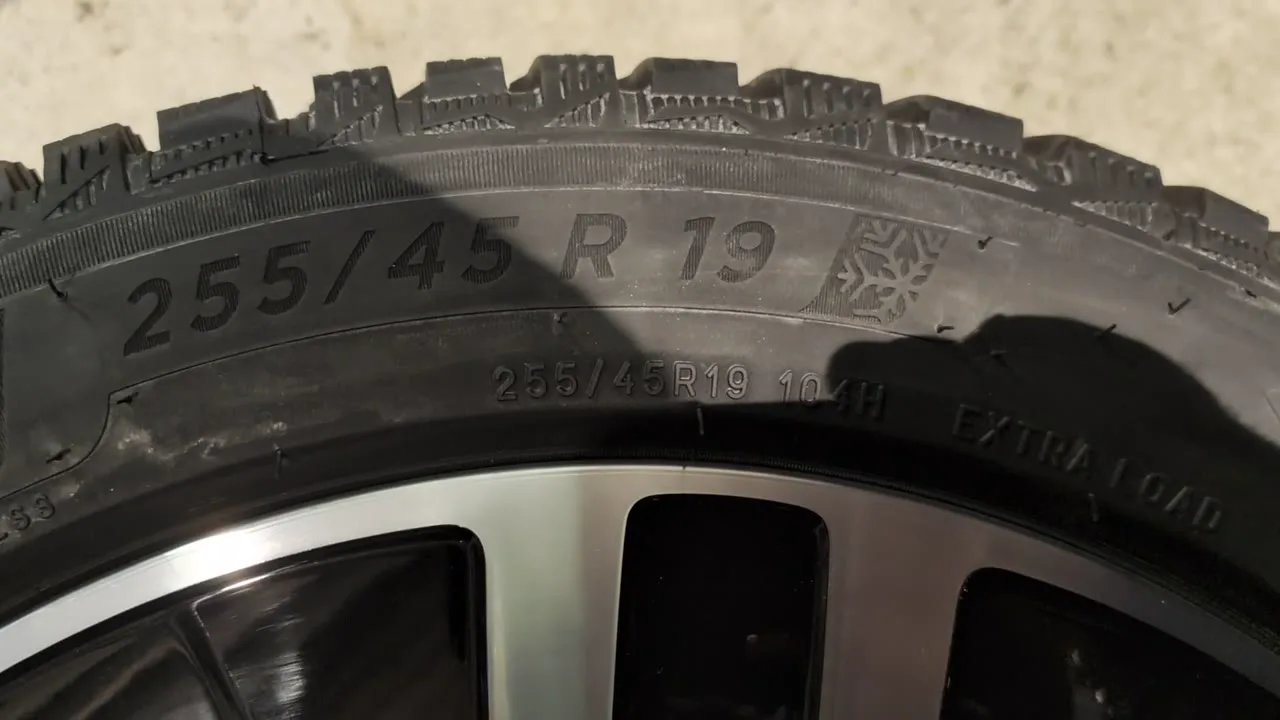
Each part of that string has a fixed meaning. The same system is on any passenger-car tyre, so it is worth reading it once properly.
| Marking | What it specifies |
|---|---|
| 255 | Section width in millimetres |
| 45 | Aspect ratio: sidewall height is 45 percent of the section width |
| R | Radial construction |
| 19 | Rim diameter in inches |
| 104 | Load index. Index 104 is 900 kg for that one tyre |
| H | Speed rating. H is 210 km/h |
| XL / EXTRA LOAD | Reinforced carcass. The load index is the rating of that reinforced tyre |
The 900 kg figure is the rating of one tyre. The plated weights of the EQE set the load the car may carry, and this tyre has to cover the load that car puts on it. The speed rating works the same way: H is 210 km/h, and the car is still driven to the limit that applies on the road.
XL, and the words EXTRA LOAD on this tyre, mean a reinforced version of the size. The pressure I use is the EQE’s pressure, from the owner’s manual or the placard, which is usually on the driver’s door jamb or inside the fuel-filler flap. The pressure figure moulded on a tyre is the maximum that tyre is built for. I set the pressures from the car’s placard, with the tyres cold, after the wheels were on and the car had been sitting.
The snowflake in the mountain outline is the three-peak mountain snowflake. It marks a tyre that has met the standard snow-traction requirement. On a studded tyre the studs are doing the ice work. The symbol is still worth seeing, because it is part of how a winter tyre is identified. Liikenneturva’s tyre page explains the winter markings, and it notes that the EU tyre label leaves studded tyres out. The markings I used are the ones on the sidewall.
The date code is often on one sidewall only, so both sides are worth a look before the wheel is on the car and the outer face is the only one you can read in the arch.
The DOT date code, week 19 of 2026
The manufacture date is the last four digits of the DOT code. The first pair is the week, the second pair is the year. Liikenneturva’s example is 2520, week 25 of 2020. The same rule makes week 19 of 2026 read 1926.
That week runs from 4 to 10 May 2026. I fitted the tyres on 31 October 2026, so they were a few months old. That is what I want from a tyre sold as new. The code is the week the tyre was cured. It is a different date from the day the shop handed them over. Rubber ages in storage as well as on the road, which is why I read the code on a new set, and why I will still know the age in a later winter when the tread depth is the number I am comparing.
The characters in front of those four digits identify the plant and the tyre for the manufacturer. Week and year are the part that tells me the age. If the oval is scuffed, the code on the opposite sidewall is the one to use. Since 2000 the date has been four digits. A three-digit date is a tyre from the previous century, and I would not accept one sold as new.
Tread depth when the tyres were new
I measured a tread block with a vernier caliper while the tyre was still new. The reading was about 8.5 mm.
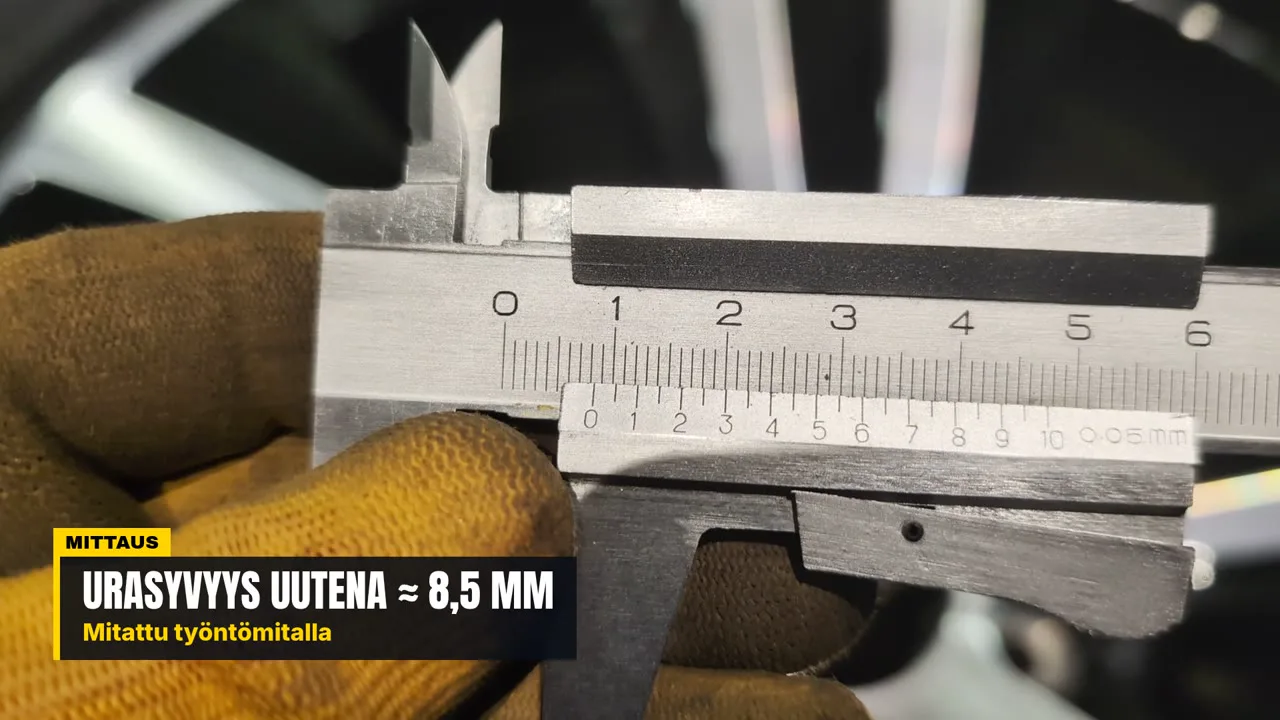
I wrote it down so a later measurement is a comparison. The habit that makes the comparison honest is to measure the main grooves, in several places around the tyre, and to use the same grooves next time. A caliper across a tread block, which is what I used here, is a fair baseline on a tyre that has not worn. Once the tyre is in service, a tread-depth gauge in the principal grooves is the usual tool, because wear is the depth of those grooves, and the main grooves are the ones the law measures.
In Finland the legal minimum for a winter tyre is 3.0 mm in the main grooves during the months when winter tyres are required. Traficom also says that in difficult snow or slush, about 5 mm is a sensible point to plan a replacement, well before the legal floor. Starting from about 8.5 mm, I have a real gap to watch, and I will measure rather than guess from the look of the tread.
Studs are a separate check. A tyre can still show tread and have shed enough studs to be a poor ice tyre. When I measure the grooves later, I look at the studs in the same pass: seated, present, and even from tyre to tyre.
The same size as a Tesla Model Y on 19-inch wheels
255/45 R19 is the size Tesla’s owner’s manual lists for the Model Y’s 19-inch wheels. The Model Y is an SUV. The EQE is a sedan. The size string on these tyres is still the same.
That is a useful check when a 19-inch tyre looks large on a saloon, because the number is a known fitment on another car I can look up. It is a poor way to choose tyres for a third car. A matching size still leaves the load index, the speed rating, and the wheel. The wheel has to fit the hub. Bolt pattern, centre bore, and offset belong to the car, and they live in that car’s documentation, not in the tyre size. I am running 255/45 R19 104H XL on this EQE. Anyone putting the same size on another car still has to match that car’s approved fitment.
The snowflake, the Extra Load line, and the 104H are doing as much work as the 255/45 R19. Two cars can share the dimensions and still need different load indexes. I kept the full service description, not only the three numbers people remember.
Where I bought them
I bought the set at Best Drive in Turku, in Kärsämäki. That is where I go when I need tyres supplied and fitted. The service on my visits has been excellent, and I recommend the shop from that experience. There is no sponsorship and no commercial tie in this article.

The video itself is the wheels going onto the car: a jack, a breaker bar, and the EQE on the drive. That is why the bolt check in the next section is mine to do, on my kilometre reading, after this change.
Stud break-in, then retighten the bolts
New studs need a seating period. The practice I am following is about 500 km of gentle driving. Through those kilometres I avoid hard acceleration and hard braking, so the studs can settle in the tread. The rubber around a new stud has to close on the stud and hold it. A hard launch or a hard stop early in that life loads the stud before it has seated, and a stud that comes out does not grow back. I wanted that 500 km started while the roads were still milder. The forecast I was watching called for frost, and possibly the first snow, about a week after I fitted them.

After any wheel has been off the car, the bolts need a second check. Liikenneturva’s tyre-change guide says to retighten the wheel bolts after 100–200 km, and to do that whenever a wheel has been removed. I will do it on this set. The reason is ordinary dirt. A grain of sand between an alloy wheel and the hub can crush as the wheel turns, and the bolts that felt tight on the jack are then slack. Checking them inside that window is what keeps the wheel seated.
The same guide is specific about how to finish the job:
- Use the torque figure in the car’s owner’s manual. For this EQE, that manual is the source I use.
- Tighten in a cross pattern, evenly, one bolt at a time.
- Do the final tightening with the car’s weight on the wheel, after it is off the jack.
- Use a torque wrench, so the bolts reach the manual’s figure. The guide points to the wrench as the way to avoid overtightening.
The same stop is a good moment to recheck the pressures cold, against the placard. A drop in outside temperature lowers pressure, and a seasonal change is when a set often sits a little off the figure the car wants. Liikenneturva suggests checking at least monthly, and again when the load in the car changes. If the pressure monitor warns after the swap, the reset steps are in the manual. I clear that before I treat the warning light as a puncture.
Studded tyres on a passenger car go on all four wheels. Liikenneturva’s tyre page says that if the car uses studs, every wheel is studded, and the stud counts on those tyres have to stay close to each other. A new matched set is the straightforward way to start inside that rule. Many winter tyres are also directional. If the sidewall has a rotation arrow, the arrow has to point the way the wheel turns once it is on the car. Swapping a wheel from one side to the other later is then a matter of keeping that arrow honest.
I keep the two reminders on different clocks. The bolt check is 100–200 km, and it should not wait for the stud seating to finish. The stud seating is about 500 km of calm driving, and it should not be cut short because the bolts have already been checked.
When studded tyres are allowed in Finland
Traficom’s page on summer and winter tyres is the rule I follow. The page is in Finnish, which is how Traficom publishes it.
- Studded tyres are allowed from 1 November to 31 March.
- Outside those dates they are still allowed when the weather or the road requires them.
- Winter tyres are required from 1 November to 31 March when the weather or the road requires them. The driver is responsible for that judgement, on the roads they actually use, including the smaller ones.
- Winter tyres can be studded or friction tyres. Studs are one way to meet the winter-tyre rule. Friction tyres are the other, and friction tyres are not limited to the studded season.
- During the period when winter tyres are required, the main grooves need at least 3.0 mm of tread. Traficom’s harder-weather guidance of about 5 mm, mentioned above, sits on top of that legal minimum.
I fitted this set on 31 October, so it would be on the car for the season that starts the next day, with a week of milder driving in hand for the studs. A friction tyre could have gone on earlier without a studded-season date to watch. With studs, the date and the weather both matter, which is why I waited until the turn of the month and still left the seating kilometres in front of the forecast frost.
FAQ
What is the full size of these tyres?
255/45 R19 104H XL. The width is 255 mm, the aspect ratio is 45, the construction is radial, and the rim is 19 inches. Load index 104 is 900 kg for one tyre. Speed rating H is 210 km/h. XL is Extra Load, also moulded on this sidewall as EXTRA LOAD.
What does a DOT code of 1926 mean?
Week 19 of 2026. On the calendar that week is 4–10 May 2026. The four digits are the week and then the year. These X-Ice North 4 tyres carry that date.
How deep was the tread when they were new?
About 8.5 mm, measured with a caliper in the video. Finland’s legal minimum for a winter tyre is 3.0 mm in the main grooves when winter tyres are required. Traficom suggests thinking about replacement around 5 mm in difficult snow or slush.
How should new studs be broken in?
About 500 km of gentle driving. I avoid hard acceleration and hard braking so the studs seat. Separately, I retighten the wheel bolts after 100–200 km, to the torque in the car’s manual. Liikenneturva is the source I use for that bolt interval.
When can I drive on studded tyres in Finland?
From 1 November to 31 March, and at other times if the weather or the road requires them. That is Traficom’s rule. Winter tyres are required in that season when conditions require them. A friction tyre is the other way to meet the winter-tyre rule, and studs, when used, go on all four wheels.
Is the YouTube video in English?
The video is in Finnish, on the Homeneer Suomi channel: Nastat alle Mersun EQE:hen – Michelin X-Ice North 4 (255/45 R19). This article is the English write-up of the same fitting.