
Where Should I Invest My Savings?
Choosing an easy, low-effort investment for a child or an adult
Many people who are starting to save or invest wonder where to put their money so they can benefit from compound interest.
I can’t give investment recommendations, because that right is reserved for companies licensed to provide investment advice. I can, however, tell you which investments I use for myself and for my child.
When the investment horizon is long (10 years or more), I invest in stocks. I think the easiest approach is to follow Warren Buffett’s advice and use low-cost equity index funds, which are simple and take very little effort.
How I would start investing in under 60 minutes
Here is a five-step list of how to get started easily. The most important thing is to start. I always regret that I started 10 years later than I could have.
- Open an account at Nordnet
- An adult can do this from the link above with online banking credentials
- For a child you have to fill in some paperwork, see my earlier post
- Set up a recurring monthly payment from your bank to Nordnet (for example on payday)
- Every bank should make it easy to set up a recurring monthly payment
- You will find the Nordnet account number and your own reference number when logged in to Nordnet:
- Portfolio -> Deposits -> Make a manual deposit
- Set up a Nordnet monthly savings plan for ETFs
- When logged in to Nordnet:
- Trading -> ETF monthly savings
- You will find my own choices and allocation below
- Set up a Nordnet monthly savings plan for funds
- When logged in to Nordnet:
- Trading -> Monthly savings
- You will find my own choices and allocation below
- Forget about it and wait
Providers
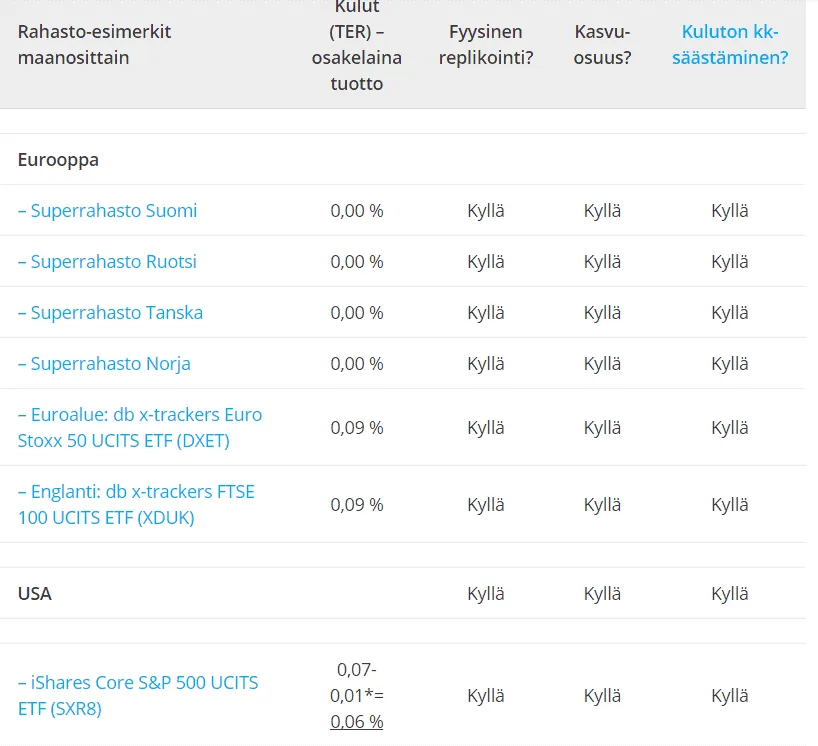
As far as I know, in Finland only Seligson and Nordnet offer low-cost equity index funds to small investors. Of these, Seligson has clearly fallen behind on costs. For example, the management fee of the Seligson Finland and Europe funds is around 0.45%. At Nordnet, the Super Suomi fund has 0% management fees and the Europe ETF 0.09%.
I have used both and have, for now, decided to direct new investments to Nordnet until a better provider comes along.
Equity index funds at Nordnet
When choosing funds, keep the following in mind:
- Low costs
- Accumulating (growth) units
- Physical replication
Martin Paasi from Nordnet has written a good blog post (in Finnish) on the topic, explaining why these things matter.
In his blog post on the world’s best ETFs, Martin Paasi lists Nordnet’s funds in a clear way.
Funds I use myself
- All the Super funds, because they have no fees
- db x-trackers EURO STOXX 50 UCITS ETF (DR) 1C (DXET)
- iShares Core S&P 500 UCITS ETF (SXR8)
Note that you can subscribe (that is, buy) the Super funds for any amount down to the euro, and you don’t need to buy whole units. ETFs are listed on the stock exchange and are traded only in whole units. At the time of writing, SXR8 is 204.07 EUR per unit and DXET 47.130 EUR per unit.
Monthly saving at Nordnet
In my opinion, the best way to invest is through fee-free monthly saving. That way you get time diversification, as fund units are bought 12 times a year at regular intervals. Everything happens automatically, and you don’t have to do anything once it is set up.
Investment plan
I diversify between the US and Europe. At the time of writing, I direct my monthly savings roughly 40% to the US and 60% to different European markets, through the Super funds and the EuroStoxx ETF.
If I had no earlier investments, I would split roughly 50% to the US and 50% to Europe. This only works, of course, if your monthly savings are large enough to use the SXR8 ETF, which costs over 200 euros per unit.
Nordnet currently has a minimum of 15 EUR per fund for monthly saving. So if your monthly amount is small, you can choose, for example, just one Super fund.
For my own child, I have for now chosen only the Suomi Super fund, which tracks the OMX Helsinki 25 index and therefore holds large Finnish international companies.